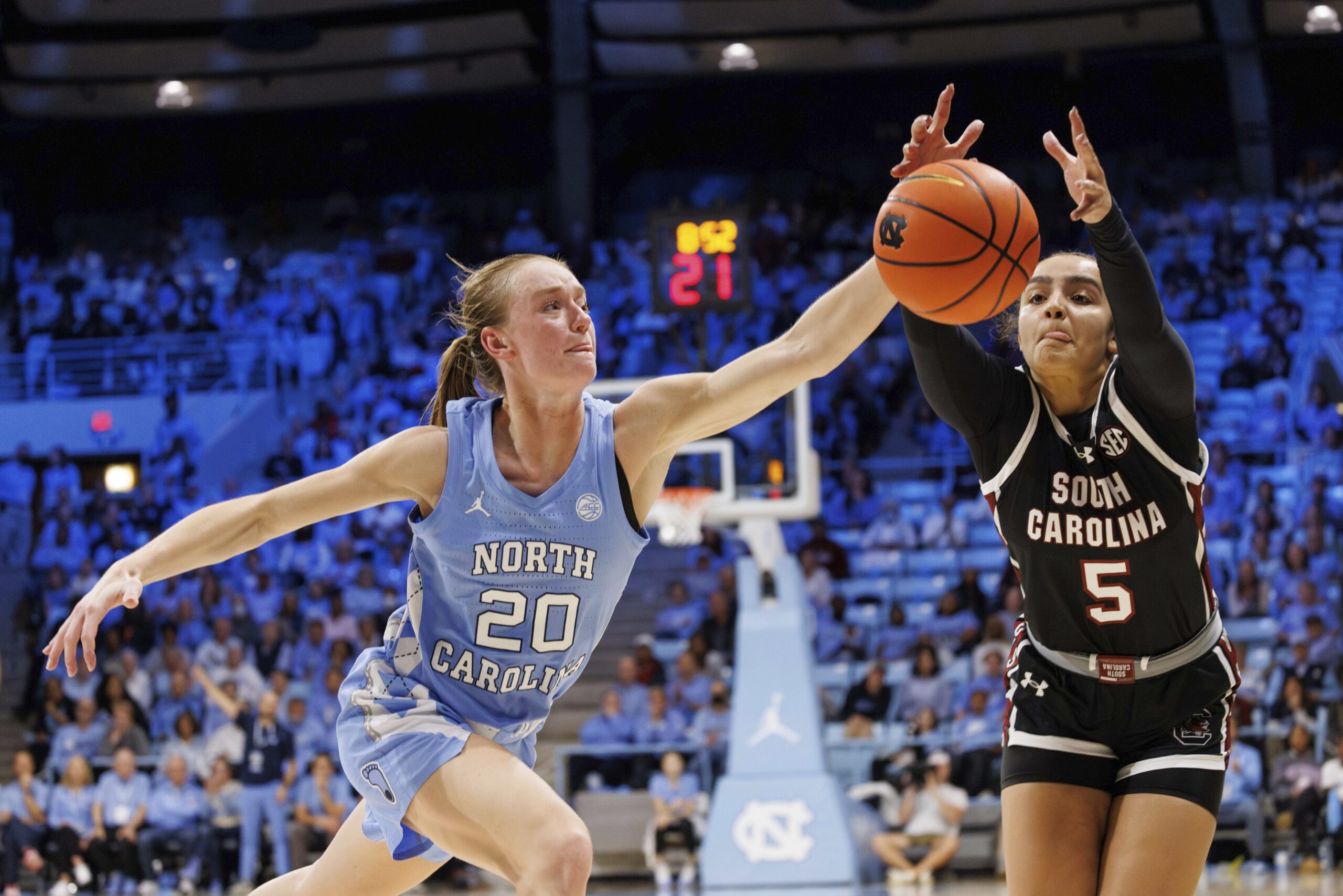
The border rivalry moves to the Spectrum Center on Sunday, when top-ranked South Carolina faces No. 12 North Carolina in the Ally Tipoff. Both teams are coming off high-scoring games in Paris, and both have things to fix. Here are the five things that could decide it.
1. A Shared Trip Across the Atlantic
By a quirk of scheduling, the Gamecocks and Tar Heels have opened the season in the same events. Both played in the Oui-Play doubleheader in Paris on Monday and now share the Ally Tipoff doubleheader in Charlotte. South Carolina beat Maryland 101-93 in the first game in Paris, and North Carolina lost to Oklahoma in the second. On Sunday, Kentucky and N.C. State play first, followed by the Gamecocks and Tar Heels.
It is mostly a fun coincidence, but it has practical value. Both teams are working through the same travel and jet lag. South Carolina returned home and practiced Wednesday and Friday, with Thursday off.
“I think we’re more intentional about some of the things we need to get better at, and I thought we got better,” Dawn Staley said.
2. A Second Showcase for the Freshmen
South Carolina’s opener pitted the Gamecocks’ second-ranked recruiting class against Maryland’s seventh-ranked group. Now North Carolina’s 10th-ranked class joins the mix.
The Paris standouts were No. 4 recruit Kate Harpring and No. 6 recruit Jerzy Robinson. Harpring led the Tar Heels with 21 points, six rebounds, five assists and two steals, though she also had seven turnovers and shot 9-for-26, missing several layups. Robinson scored 15 points on a more efficient 5-for-10, adding six rebounds, two assists and a steal, though she wants to trim her four turnovers.
The two know each other well. They were roommates on the gold-medal-winning 2025 USA Basketball U19 World Cup team.
“She’s a very accomplished player, Naismith Player of the Year, so she’s great. She’s awesome,” Robinson said. “We’re pretty close. But when it comes between those lines, she knows how it gets.”
The other freshmen had quieter debuts. North Carolina’s Noelle Bofia, ranked 57th, played seven minutes and finished with two points and four rebounds, showing promise as an athletic forward. For South Carolina, Kelsi Andrews and Justine Loubens played a combined five minutes and totaled two steals, a block and an assist. Oliviyah Edwards did not play, nor did the injured Kaeli Wynn. Staley had hoped to give Andrews, Loubens and Edwards fourth-quarter minutes, but Maryland’s comeback changed the plan.
“They should have played,” Staley said, still frustrated over the blown halftime lead. “If we had kept the lead, there’s more opportunity for people to get some minutes. But when it got down to 10 (points) and then a two-possession game, you’ve got to go with the people that have been there.”
3. Taking Care of the Ball
Each team committed 17 turnovers Monday. That isn’t a disastrous total, but it is higher than either would like. The concern for South Carolina is that North Carolina, like Maryland, uses a full-court press. The Tar Heels also shift into multiple zone looks in the half court, which Maryland used to great effect in the second half.
South Carolina turned the ball over 10 times after halftime, and those miscues produced 18 Maryland points. In the first half, when the Gamecocks kept Maryland from setting its defense, the Terrapins scored only six points off turnovers.
“I think taking care of the ball is always one of the big things,” Robinson said. “We play great competition. So that’s definitely one of them. Playing together and flowing through offenses, hard cuts, things like that. Just being very intentional with every movement.”
The effect was just as dramatic for South Carolina’s own offense. The Gamecocks scored 21 points off 13 forced turnovers in the first half but only four points off three in the second. North Carolina, despite its own giveaways, won the turnover battle against Oklahoma, forcing 21 turnovers that produced 27 points and kept the game from getting out of hand.
4. Two Defensive Teams, Two Uncharacteristic Nights
Defense is the identity of both programs, which made it jarring to see them allow 93 and 91 points in Paris. Much of the credit belongs to Maryland and Oklahoma, two of the nation’s stronger offenses. But many of the defensive problems started at the other end. Along with the turnovers, poor shot selection kept both teams from getting their defenses set.
The numbers were strikingly similar. South Carolina shot 40.0 percent after halftime, starting with a 6-for-18 third quarter. North Carolina shot 36.4 percent in the second half, including 6-for-20 in a decisive third quarter. The Tar Heels also struggled to convert even good looks, going 13-for-27 on layups and 10-for-17 at the free-throw line.
5. Scouting the Tar Heels
Under Courtney Banghart, North Carolina has defended well but has struggled to score. This season was supposed to bring improvement, thanks to Harpring, Oklahoma State transfer Achol Akot and the return of Nyla Brooks and Reniya Kelly. One game in, the results are mixed. Harpring took 26 shots, too many for anyone, much less a freshman, and 40 of North Carolina’s 86 field goal attempts were three-pointers. The Tar Heels and Maryland play similar defense, but their offenses diverge on the perimeter.
Staley laid out the differences herself:
“A lot of the things that Maryland does, but they shoot a lot more threes. I think against Oklahoma, 40 out of 86 field goal attempts were threes. They like to get them up. They like to play at a fast pace and to get up and down the floor. They’ve got some guards that can shoot it. I think Harpring presents a problem because she’s super competitive, can knock down open threes, (and) can create and playmake for other people. She’s a really solid player as a freshman. But they’ve got other key pieces that just do their job. They’re a physical basketball team. They rebound the ball extremely well, and we’ll be challenged on Sunday.”
Five Tar Heels reached double figures against Oklahoma, but only Harpring scored more than 13. North Carolina would like more balance, and a better showing than its 27.5 percent from three-point range.
South Carolina has its own perimeter concerns. Maryland shot 43.3 percent from deep, including 9-for-15 in the second half, and sophomore Addi Mack went 6-for-10 from three on her way to a career-high 35 points. Her open looks were a focus in South Carolina’s practices this week.
“Maryland was more of a driver team, a slashing team, and UNC is really, really effective from the outside,” Robinson said. “Quick shots, transition threes, things like that. Very dangerous from the arc, so we’ve got to focus on that.”
Bottom Line
This matchup comes down to which team cleans up its Paris mistakes first. Both defenses gave up far too many points, and both got there through turnovers, rushed shots and lapses after halftime. South Carolina has the deeper roster and the recent edge in the series, but the same second-half slide that nearly cost it against Maryland could be exploited by a North Carolina team that presses, switches defenses and shoots threes in volume. If the Gamecocks protect the ball, contest the arc and get a full 40 minutes, they should leave Charlotte unbeaten.

